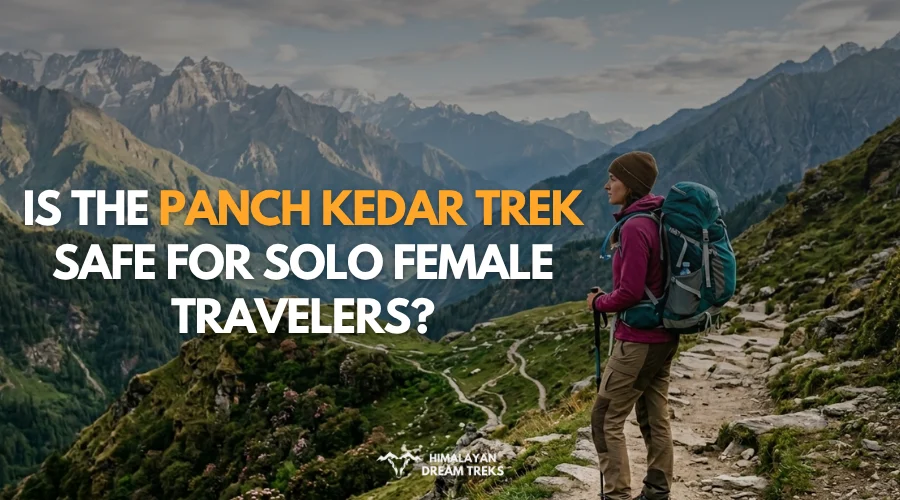
Firstly, kudos on making up your mind for this trip all by yourself, as it is going to be a wholesome and heartwarming experience. The Himalayas do not bargain, and they certainly do not offer “safe spaces”, they offer wilderness, raw and unfiltered. For the growing community of solo female travelers, the Panch Kedar circuit, a rugged tapestry of five sacred Shiva temples hidden in the Garhwal Himalayas, is perhaps the ultimate litmus test for independence; it is a path that demands both reverence and razor-sharp logistical foresight.
Here is the reality: nearly 35% of all our trekkers on Himalayan trails are now women, a statistic that reflects a massive shift in how we explore our own mountains.
Is it safe for a solo female traveler to trek these valleys alone? The answer is a resounding yes, but only if you abandon the myth of a uniform trail and embrace a strategy of surgical, leg-by-leg planning. You are not walking one single Panch Kedar trek; you are navigating five distinct micro-environments where the difference between a transformative spiritual journey and a difficult isolation is measured entirely by
- Your preparation,
- The season, and
- Tour willingness to hire local support for the most remote ascents.
Table of Contents
What it means to trek Solo in Panch Kedar?
It is crucial to recognize that Panch Kedar is not one continuous, standardized trail; it is a pilgrimage circuit spread across distinct valleys, each with its own topography, local culture, and infrastructure. While popular routes like the Kedarnath trek have become highly commercialized with significant daily footfall, police presence, and medical support, others like the Rudranath trek or the Madhmaheshwar trek remain stark, remote, and physically demanding, where you might not see another soul for hours.
When we discuss solo travel safety in Panch Kedar context, we aren’t just talking about personal saftey; we are discussing the trinity of Himalayan trek safety: environmental predictability, logistical backup, and communication access.
Because each of the five temples, Kedarnath, Tungnath, Rudranath, Madhmaheshwar, and Kalpeshwar, offers a unique environment, your solo trekking guide or plan cannot be a “one-size-fits-all” model.
Safety and Suitability: A Comparative Breakdown
Have a look at the five legs of the circuit based on the typical experience for a solo female traveller:
| Temple Route | Solo Suitability | Primary Risk Factor | Support Level |
| Kedarnath | High | Crowd management | High |
| Tungnath | High | Weather volatility | High |
| Kalpeshwar | Moderate | Not as such | Good |
| Madhmaheshwar | Moderate | Steep, demanding terrain | Medium |
| Rudranath | Low | Extreme remote terrain, Steep | Low |
Anecdotes from the Trail
To understand the solo female trekking experience, we must look at the stories of those who have already walked these paths. Many women who have completed the Panch Kedar circuit emphasize that the biggest challenges were rarely related to safety, but rather the logistical hurdles of managing long distances alone.
One traveler shared that her journey to Madhmaheshwar felt like a profound shift in her self-reliance. She noted that while the solitude was initially daunting, the hospitality of the local families in the village of Goundhar made her feel incredibly secure. She often arrived at small, family-run guesthouses where the hosts would treat her like a daughter, ensuring she had a warm meal and a safe place to sleep before the next day’s climb.
Another female trekker, who attempted the Rudranath trek, admitted that she felt completely unprepared for the isolation. She recounted that without a local registered guide, she would have struggled to navigate the dense, unmarked forest paths after a sudden spell of fog.
Her experience underscored a vital point: in the most remote sections, your autonomy is best served by having an expert by your side, not by proving you can manage everything yourself.
A third traveler who specialized in shorter, accessible segments like Tungnath and Kalpeshwar emphasized the importance of the “pilgrim network.” She found that by timing her trek during peak season, she was never truly alone. Walking alongside elderly pilgrims and local families created a protective, supportive social environment that allowed her to enjoy the serenity of the mountains without the anxiety of total isolation.
Is Panch Kedar Safe For Women?
The reality for a woman navigating Panch Kedar solo is rarely about active threats, but rather the vulnerability that comes with isolation. In regions with patchy network coverage and limited medical facilities, a minor sprained ankle or a sudden bout of altitude sickness transforms from an inconvenience into a critical issue.
When preparing for your adventure travel in India, shift your focus from “What if something happens?” to “How do I ensure I am not alone when it does?” This means:
- Pre-booking stays: Avoid the uncertainty of arriving at a village without a confirmed bed, which not only ensures privacy but also provides a layer of social vetting by the host.
- Hygiene and privacy: Pack for the reality of basic, shared facilities; bringing a personal sleeping bag liner and sufficient hygiene supplies is as much about comfort as it is about maintaining your health.
- Offline connectivity: Never rely on mobile data; carry physical maps and an offline navigation app (Alltrails, Gaia GPS), and ensure your emergency contacts are briefed on your daily route and expected arrival times.
Where Safety Becomes Non-Negotiable
While independence is the goal, there are zones where it becomes a liability. The high-altitude forest stretches, particularly on the way to the Rudranath temple, are areas where a solo trek becomes more of a logistical gamble than a test of strength. If you find yourself in a section where you haven’t seen another human in hours and the weather is shifting, your “solo” status is no longer an asset.
In these moments, “safe” is not synonymous with “unaccompanied.” I strongly recommend that for these specific, more isolated legs, you hire a Tour Operator. This is not a compromise of your autonomy, but an intelligent strategy to ensure you have an expert who understands the terrain, can manage emergencies, and can navigate local social dynamics.
Safety for Women: An Honest Take
Yes, the Panch Kedar trek for women can be safe, but only when you match your route choice with the right level of support. The honest answer is that safety is not the same on every leg. Kedarnath, Tungnath, and Kalpeshwar are more manageable because they see more footfall and have better support, while Rudranath and parts of Madhmaheshwar are far more remote and should not be treated casually.
So the real question is not “Is the whole trek safe?” but “Which leg are you doing, in which season, and with what backup?”
For women travelling alone, the main risk is usually not direct danger but isolation, weather change, and weak support in case something goes wrong. A woman can feel perfectly comfortable in a busy pilgrim zone and then feel uneasy two hours later on a quiet forest stretch with no network and no one in sight.
That is why the safest approach is to travel with a guide on harder legs, pre-book your stay, and avoid late starts. If you ask me plainly, the trek is safe for women who prepare well, respect the route, and do not confuse independence with unnecessary risk.
Taking Support during Solo Travel – Locals and Male Co-Trekkers
On the Panch Kedar trek, most male co-trekkers are there for the same reason you are: darshan, mountain air, and a tough but meaningful journey. In practice, this usually means you will meet people who are polite, curious, and more focused on the trail than on anyone else’s personal space.
In pilgrim-heavy stretches like Kedarnath and Tungnath, the atmosphere is usually respectful because the route is strongly rooted in faith and local custom. For a solo woman, that matters a lot, because the social mood on the trail often feels safer than on casual tourist routes.
What many women notice is that help comes in small but important ways. A fellow trekker may offer walking company for a steep section, a local tea stall owner may remind you to start early, or a homestay host may quietly check whether you reached the next stop safely.
In the villages around the route, people are generally used to pilgrims, porters, and trekkers passing through, so there is a practical kindness in the way locals respond to travellers. Still, trust should be built carefully. Be friendly, but keep your boundaries clear, share your plan only with people you trust, and avoid oversharing your solo movement details at the start.
Strategies for Informed Independence
- Start before dawn: Always aim to reach your next destination well before sunset, as mountain trails behave very differently after dark.
- Leverage the pilgrim network: Even when trekking solo, try to time your movement with other groups of pilgrims or trekkers; there is a natural safety in the loose, fluid community that forms on these paths.
- Verify, then book: Use reputable local agencies or verified homestay hosts who can provide you with reliable information on Panch Kedar trek conditions, which change rapidly after rain or snow. Need help planning your Panch Kedar Yatra? We at Himalayan Dream Treks are well known for creating customized travel according to our customers’ needs. Contact us at info@himalayandreamtreks or +91-8089693825.
The Emotional Landscape of Solo Trekking
Ultimately, the significance of a solo Himalayan trek is the profound, unmediated connection with the landscape. There is a specific kind of clarity that arises when you are the only person responsible for your pace, your rest, and your survival.
You need not worry about coordinating with other people or timing your trek as per someone else’s wished or desires. However, this clarity is only possible when you aren’t fighting off unnecessary anxiety that comes with. By opting for support in the most challenging sections and choosing the more accessible legs for your solo travel experiments, you allow yourself the space to actually experience the majesty of the Himalayas.
You aren’t trekking to prove a point; you are there to find peace, and the safest way to find that is to plan for the journey with the same depth that you put into your own personal growth. So make your checklist, pack your bag, and conquer the treks at your own pace!

Leave a Comment