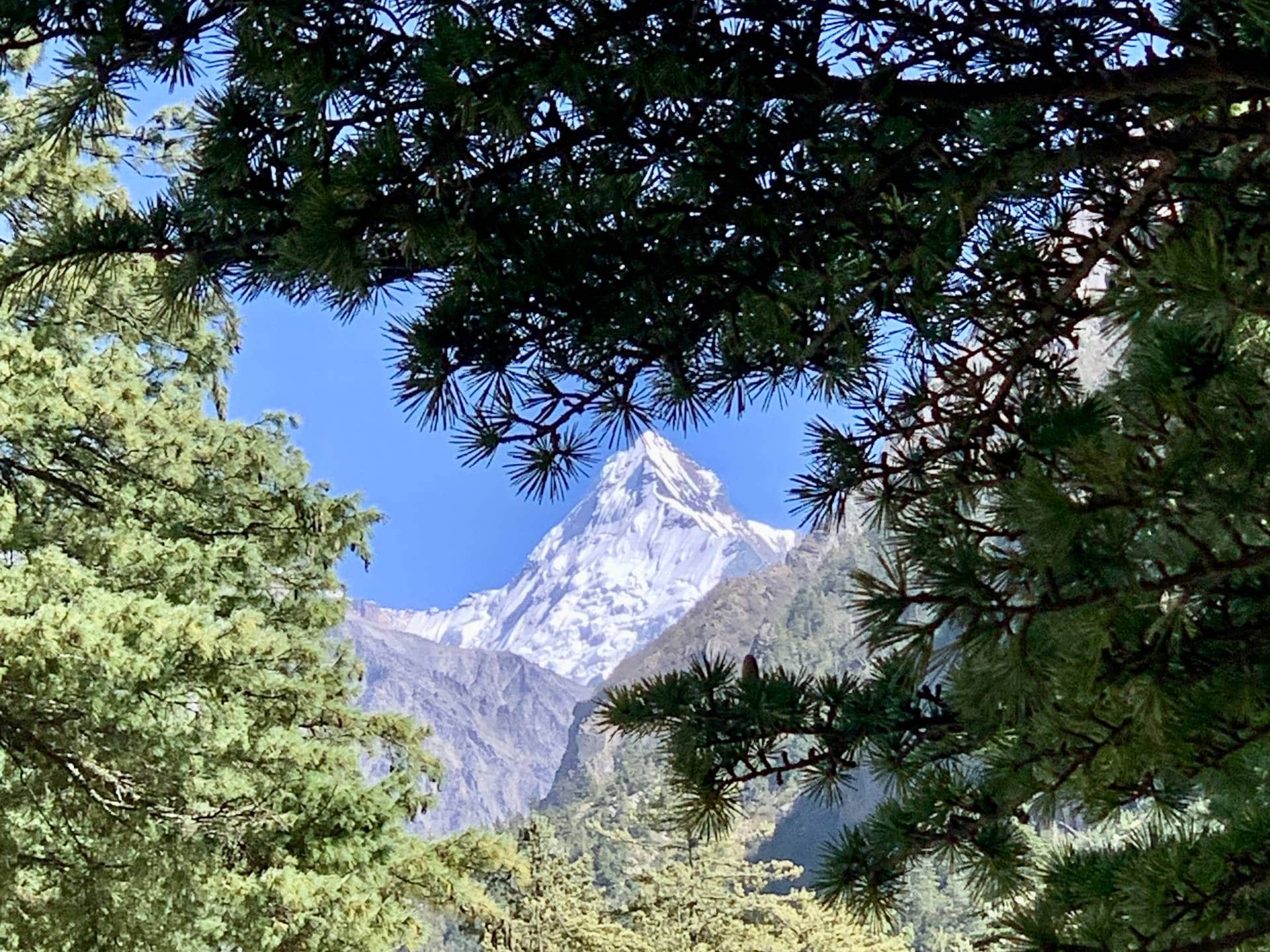
Imagine trekking through a rugged stretch of ice and moraine, where every step brings you closer to a striking peak shaped like a perfect wedge of stone and snow. That imposing giant is Sudarshan Parbat, standing quietly yet powerfully in the Garhwal Himalaya.
As you look upward from the glacier’s edge, it’s easy to sense how many stories this mountain holds – the determination of climbers before you, the harsh winds carving through high ridgelines, and the excitement of a route still untouched by most. This is a peak that asks for resilience and respect; in return, it reveals a raw and rare connection to the true spirit of the mountains.
Table of Contents
Climbing History
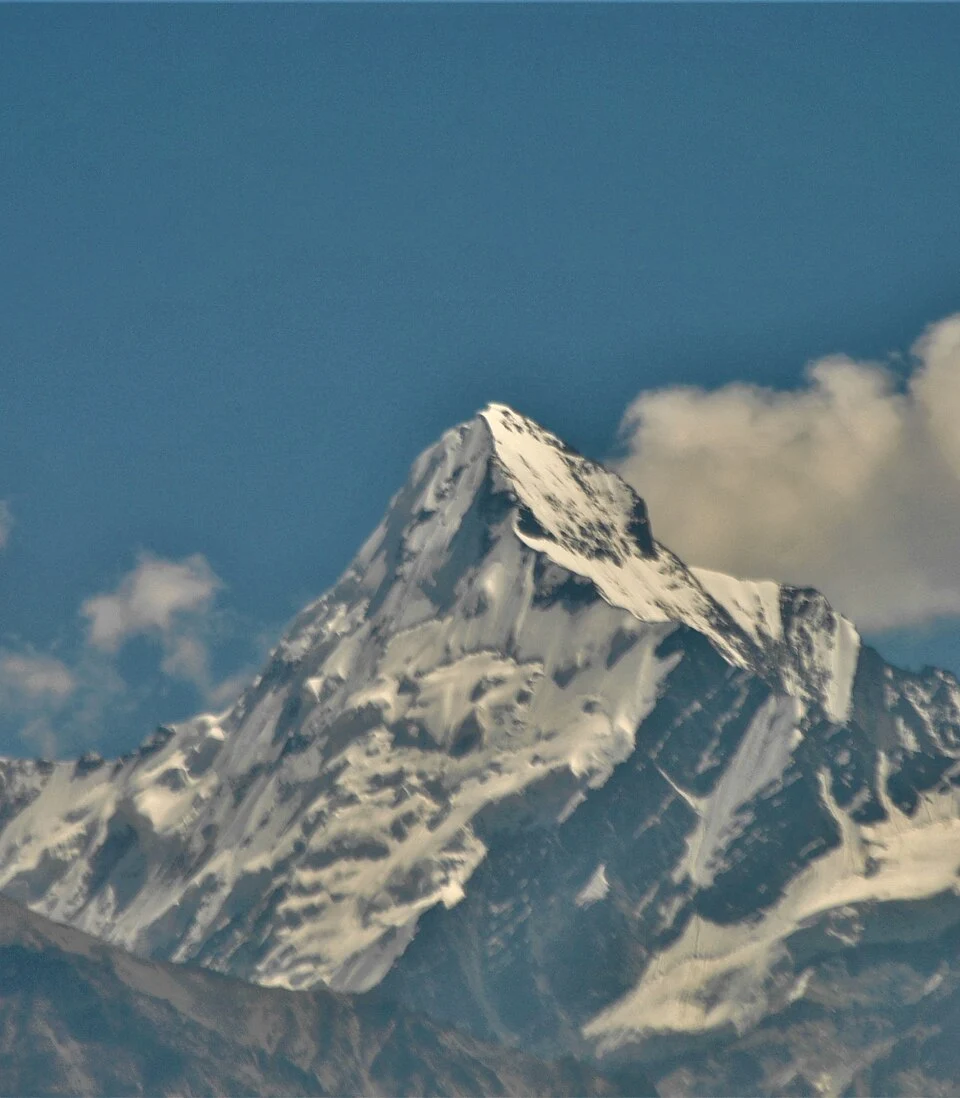
Sudarshan Parbat, rising to approximately 6,529 meters (21,421 ft), is in the Garhwal Himalaya of Uttarakhand, India. Its first confirmed ascent was by a joint Indo-French expedition led by Harish Kapadia on 30 May 1981, tackling the peak via its steep east ridge.
The team comprised eleven climbers, four from France and seven from India, including Hubert Odier, Alain de Blanchaud, Zerksis Boga, Lakhpa Tsering, Bernard Odier, and Jacques Giraud, who fixed around 1,500 feet of rope across technical ice sections. The climb involved mixed terrain: steep ice, narrow ridges, and exposed cornices, culminating in a final summit push that started around 4 a.m. and, in the thin dawn light, reached the top after grappling with one of the most technical portions.
Before that successful expedition, Sudarshan Parbat had seen several attempts. For instance, a Himalayan Association team from Calcutta in 1979 came close but was turned back. Earlier misclaims also surfaced – a group in 1972 reported a summit, only for later analysis by J. C. Nanavati to clarify that they had climbed a lower neighboring peak (Koteshwar I).
Over the years, other expeditions followed. In 2002, Giripremi, an Indian civilian institution, made a successful ascent via the south-west ridge. Modern adventure companies also run commercial climbs, often using the west ridge route and establishing multiple camps on the Raktavarn Glacier.
When to Climb
Timing is crucial when planning a climb of Mount Sudarshan Peak. The most feasible windows are during the pre-monsoon (May–June) and post-monsoon (September–October) seasons. During these periods, the weather offers a relatively stable balance: the snow is more consolidated, and the risk of avalanches or unstable snow-pack is reduced. The first ascent itself was in late May – a testament to the suitability of that window.
Map & Route Overview
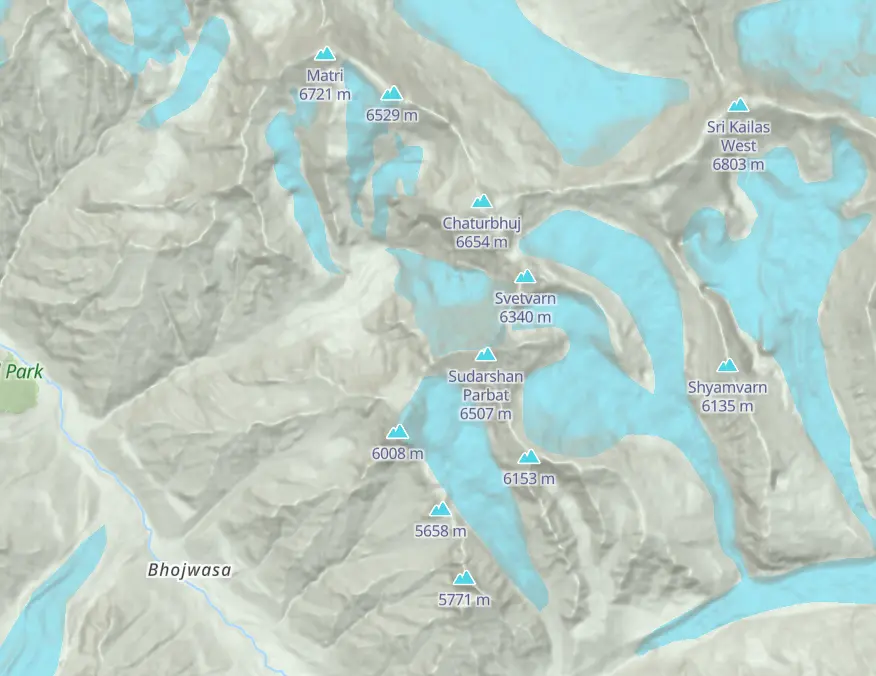
Geographically, Sudarshan Parbat lies in the Uttarkashi district of Uttarakhand, with coordinates approximately 30.9768° N, 79.094° E.
The mountain is flanked by significant neighboring peaks: Chaturbhuj (6,654 m) to the north, Yogeshwar (6,678 m) to the northeast, Swetvarn (6,340 m), Thelu (6,000 m), and Koteshwar I (6,080 m).
One common route is via the Raktavarn Glacier, from which climbers establish multiple high camps. Commercial teams tend to take the west ridge, while the first ascent followed the more challenging east ridge, crossing steep ice walls and narrow ridgelines.
Permits & Logistics
To climb Sudarshan Peak, you will need:
- Mountaineering permits from the Indian Mountaineering Foundation (IMF). Depending on the season and team size, regulation and permit fees may vary.
- Liaison Officers (LO): Indian government requires expedition groups to take LOs who accompany the team.
- Local logistics: Transportation from the nearest town (e.g., Uttarkashi) to base camp, porters or yaks for carrying loads, high-altitude equipment, ropes, tents, food, cooking gas.
Why Climb Sudarshan Parbat and What to Expect
- Technical challenge: The east ridge (the first ascent route) features steep ice cliffs, razor-sharp ridges, and exposed terrain.
- Remote and pristine: Unlike some more popular peaks, Sudarshan offers solitude, fewer commercial teams, and an experience that feels genuinely exploratory.
- Scenic value: The mountain overlooks the Gangotri Glacier, with a view of peaks like Shivling, Yogeshwar, and Chaturbhuj.
- Cultural resonance: Its name comes from Hindu mythology – “Sudarshan” is associated with the discus weapon of Lord Vishnu, and its surroundings include peaks named in mythological contexts.
Risks & Considerations
Before you plan such an expedition, you must be honest about the risks:
- Altitude: Over 6,500 m means a serious risk of acute mountain sickness. Proper acclimatization is non-negotiable.
- Technical climbing: Not just trekking – this is a mountaineering climb with fixed ropes, steep ice, and possibly corniced ridges.
- Weather: Himalayan weather is unpredictable. There may be storms, high winds, or significant snow – contingency days must be included.
- Logistics: Remote glacier access, porters, camps, and evacuation planning are all complex and expensive.
- Permit and regulation: Proper paperwork, LOs, and environmental compliance are essential.
Budget & Cost Overview
Planning an expedition to Sudarshan Parbat involves organizing technical equipment, experienced support, and glacier-based logistics. Since this peak requires roped climbing, load ferrying, and camp setup on ice, the expenses are higher than a regular Himalayan trek. Typically, a full expedition lasts around 20-24 days, and the overall cost varies depending on how the trip is structured.
The total expenditure generally depends on:
- Number of climbers in the team
- Type of support chosen (full-service expedition vs. semi-supported)
- Climbing style (multiple fixed camps vs. a lighter alpine approach)
- Technical equipment required for steep ice and ridge sections
- Permit rules, liaison officer requirements, and seasonal regulations
- Number of rest or acclimatization days due to weather
You should also account for:
- Travel to and from Uttarakhand
- Individual gear, clothing, and safety equipment
- Rescue insurance or high-altitude evacuation coverage
- Tips and additional unforeseen logistics
Because this is a technical and remote Himalayan climb, it is wise to set aside some extra funds as a safety margin for unexpected delays or changing route conditions.
Final Thoughts
By the time you trace the icy ridges of Sudarshan Parbat in your mind, you realize that this mountain offers more than a summit. Its history challenges you to dream bravely, its terrain pushes you to climb deliberately, and its silence invites you to listen. As you imagine stepping onto its slopes, you’re not just preparing for an expedition; you’re stepping into a legacy shaped by explorers who valued endurance over fame.
If you choose to take on Sudarshan Parbat, you choose a journey that transforms how you see the mountains and yourself.

Leave a Comment