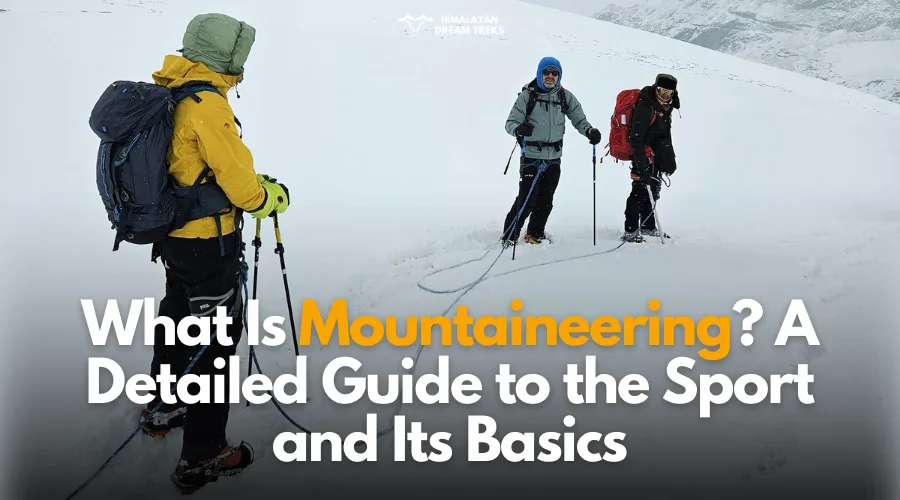
Mountaineering or mountain climbing is a technical sport of conquering high-altitude summits. This adventure activity involves ascending the hills, hiking and trekking on the tough terrains, and finally, enduring the challenges of rock and ice climbing.
Also known as Alpinism in European languages, it is often a group activity where a team of mountaineers covers the technical sections of a mountain for safety and support. Mountaineering requires physical fitness and long-term training in safety protocols, specialized equipment, and the patience to learn from the peaks themselves.
The nature of human curiosity has led several mountaineers to scale some of the most risky summits in the world, from Mont Blanc in the Alps to Mt. Everest in the Himalayas. Want to start your climbing journey? Scroll down to learn the origin of mountaineering, its various types, and how to get started.
Table of Contents
History of Mountaineering
The history of mountaineering dates back to the very existence of humans on Earth. In ancient times, locals living in the higher altitudes had to survive the tough terrains by mastering their climbing skills. While the evidence of climbing can be found in the prehistoric era, its recreational aspect can be traced back to 1336, when a French scholar, Petrarch, climbed the Mont Ventoux. Since then, many recorded accounts mention the act of climbing hills for trade and adventurous explorations. These include:
- 1492: Antoine de Ville, a French military officer, ascended Mont Aiguille (2,085 m) on behalf of King Charles VIII of France. He used ropes, ladders, and iron hooks, making it the first documented climb of technical difficulty.
- 1786: Jacques Balmat and Michel-Gabriel Paccard made history by ascending Mont Blanc, Europe’s highest peak at 4,807 meters. This inspired several other mountaineers who conquered this peak in the Alps.
- 1857: The world’s first mountaineering organization, the Alpine Club, was founded in London.
- 1865: Edward Whymper and his team climbed Mt. Matterhorn of the Swiss Alps for the first time.
- 1950: French climbers Maurice Herzog and Louis Lachenal summited Annapurna I (8,091 m).
- 1953: The ascent of Mount Everest by Edmund Hillary and Tenzing Norgay.
- 1954: Italian mountaineers Lino Lacedelli and Achille Compagnoni reached K2’s summit via the Abruzzi Spur.
- 1978: Reinhold Messner and Peter Habeler achieved the first ascent of Mount Everest without supplemental oxygen.
- 1986: Reinhold Messner became the first person to complete the ascent of all fourteen eight-thousanders without using supplemental oxygen on any peak.
- 2010: Spanish mountaineer Edurne Pasaban became the first woman to summit all fourteen eight-thousanders.
Mountaineering in India
In India, mountaineering as a sport has colonial foundations, where British officers viewed the Himalayas as a subject of conquest and exploration. One of the earliest examples is George Everest, the Surveyor General of India, who conducted the Great Trigonometrical Survey to map the Himalayas in the 19th century.
This led to the world’s highest mountain being named after his name, even though he never climbed it. Many Indians took part in this attempt to map the highest regions in India, making them some of the earliest Indian mountaineers.
- 1947: The Himalayan ranges became a symbol of national identity and defense for post-independence India.
- 1951: Gurdial Singh became the first Indian to climb a Himalayan Peak and led the expedition to Trisul. Gurdial Singh led an expedition to Trisul (6,971 m) and became the first Indian to climb a major Himalayan peak.
- 1953: Tenzing Norgay, a resident of India, summited Mt. Everest, putting India on the map of mountaineering achievements.
- 1954: Inspired by Tenzing’s contributions, Prime Minister Jawaharlal Nehru established the Himalayan Mountaineering Institute (HMI) in Darjeeling.
- 1957: To propel the growing interest of mountaineering among young climbers, a ‘Sponsoring Committee of the Cho Oyu Expedition’ was established. This led to India’s first successful ascent of an eight-thousander peak.
- 1961: The Cho Oyu Committee was made a permanent national organization, established as the Indian Mountaineering Foundation. This became the apex body for the mountain sports, expeditions, and related funding.
- 1965: The IMF organized an expedition under the leadership of M.S. Kohli. Under this, Avtar Singh Cheema became the first Indian to summit Mt. Everest. This success resulted in the establishment of the Nehru Institute of Mountaineering (NIM).
- 1984: Bachendri Pal became the first Indian woman to summit Everest, breaking the barriers of gender bias in mountaineering as a sport.
Since then, the 21st century has seen many mountaineers who have made successful attempts at alpine-style climbing. These include some of the highest Indian peaks, like Nanda Devi, Kamet, Trisul, and Nanda Kot, among others. In 2017, Harish Kapadia became the first Indian to receive the Piolet d’Or Asia Lifetime Achievement Award for traversing unknown valleys and documenting notable expeditions and routes.
All these mountaineering achievements also owe it to the Sherpa community and porters, who, with their high-altitude knowledge, helped navigate difficult terrains and manage camps.
Types of Mountaineering
Rock Climbing
In rock climbing, mountaineers attempt the technical ascent of steep mountain faces. This involves using a removable gear, such as ropes, a harness, and other equipment, to secure the rope in cracks and ascend. To attempt this, you must be physically fit for optimum strength and balance, and must interpret the natural lines of the mountain.
Alpine Climbing
In alpine climbing, mountaineers use equipment like crampons, ice axes, and snowshoes for their continuous summit push. They climb over high-altitude glaciers, ridges, and other technical sections of a snow-covered mountain. In alpine climbing, speed and efficiency in climbing are important factors to minimize exposure to mountain hazards.
Ice Climbing
This is one of the most dangerous forms of mountaineering, where one ascends frozen waterfalls, rock faces, and near-vertical glacial slopes. It requires the use of technical climbing tools like ice axes and crampons, metal spikes attached to the boots, to secure themselves to the frozen surface. This climbing involves intense training and experience of scaling frozen terrain, where the temperature remains unpredictable.
Expedition Climbing
An expedition is done to summit the highest point of some of the high-altitude ranges, like the Himalayas. This is usually attempted by a team where they set up fixed camps and moves supplies between them over several weeks. This helps their body to acclimatize.
Mixed Climbing
This is a type of mountaineering that involves ascending through the mixed sections of a trekking route. In this, one climbs the rocky terrain with boulders and moraine, as well as frozen sections of the mountains. It requires the use of hooks and crampons. Mixed climbing requires the experience of both rock climbing and ice climbing.
Ski Mountaineering
Ski mountaineering, or Skimo, involves ascending a mountain while descending with a ski. For uphill traction, mountaineers use skins under their skis and later remove them when moving downhill. This is a faster method to move across snowfields than climbing on foot.
Snowshoeing
This form of mountaineering requires the use of a snowshoe to traverse the deep and powdery snow on the slope of a mountain. This prevents one from sinking deep into the snow by distributing their weight evenly on the climbing surface. Snowshoeing is often less demanding and can be attempted by people of all ages and fitness levels.
Hotspot of Mountainering: Alps, Andes, Altai, Himalayas (Nepal, India)
Alps
- Geography: The Alps are located in south-central Europe, stretching in a crescent form from France to Austria. The length of the range is about 1,200 km, and it is considered the birthplace of mountaineering as a sport. Many of Europe’s important rivers, like the Rhone, Rhine, Po, along with important tributaries of the Danube river, originate from here.
- Peak Height: Mont Blanc at 15,777 ft (4,809 m)
- Average Elevation: Approximately 8,202 ft (2,500 m)
- Famous Peaks
| Peak | Elevation (m) | Location |
| Mont Blanc | 4,809 | France/Italy |
| Monte Rosa | 4,632 | Switzerland |
| Matterhorn | 4,478 | Switzerland/Italy |
| Breithorn | 4,164 | Switzerland |
| Weissmies | 4,017 | Switzerland |
- Average Cost Of The Expedition: USD 2,000 – 7,000
Andes
- Geography: The Andes are the world’s longest continental mountain range, stretching 8,900 km along the western coast of South America. They span seven countries, from Argentina to Venezuela, in a north-south direction. They are located along the Pacific coastline, separated by coastal deserts. The Andes feature high-altitude plateaus and volcanic summits like Chimborazo.
- Peak Height: Mount Aconcagua at 22,818 ft (6,957 m)
- Average Elevation: Approximately 13,000 ft (3,962 m)
- Famous Peaks
| Peak | Elevation (m) | Location |
| Aconcagua | 6,957 | Argentina |
| Ojos del Salado | 6,893 | Chile/Argentina |
| Chimborazo | 6,263 | Ecuador |
| Huascarán | 6,768 | Peru |
| Tupungato | 6,570 | Argentina/Chile |
- Average Cost Of The Expedition: USD 3,000 – 12,000
Altai
- Geography: The Altai Mountains are located in Central Asia, marking the region where Russia, China, Mongolia, and Kazakhstan meet. Stretching for about 2,000 km in a southeast-northwest direction, these ranges cover the Gobi Desert to the West Siberian Plain. It is known for its untouched terrains, alpine glaciers, and serves as an uncommercialized alternative to the Alps and Andes.
- Peak Height: Mount Belukha at 14,754 ft (4,497 m)
- Average Elevation: Approximately 8,566 ft (2,611 m)
- Famous Peaks
| Peak | Elevation (m) | Location |
| Gora Belukha | 4,497 | Russia |
| Khuiten Peak | 4,334 | Mongolia |
| Nairamdal Peak | 4,180 | Mongolia/Russia/China |
| Malchin Peak | 4,050 | Mongolia/Russia |
- Average Cost Of The Expedition: USD 1,200 – 5,005
Himalayas (Nepal, India)
- Geography: The Himalayas are the highest mountain system on Earth, stretching 2,400 km in the southeast Asia. They run in a west-to-east direction and pass through India, Pakistan, Afghanistan, China, Bhutan, and Nepal, dividing the Indian subcontinent and the Tibetan Plateau. This range is one of the most popular hotspots of mountaineering with fourteen 8,000-m peaks that test your endurance.
- Peak Height: Mount Everest at 28,766 ft (8,768 m)
- Average Elevation: Approximately 20,000 ft (6,100 m)
- Famous Peaks
| Peak | Elevation (m) | Location |
| Mount Everest | 8,768 | Nepal/China |
| Kangchenjunga | 8,574 | Nepal/India |
| Lhotse | 8,360 | Nepal/China |
| Dhaulagiri I | 8,140 | Nepal |
| Annapurna I | 8,091 | Nepal |
| Nanda Devi | 7,816 | India |
- Average Cost Of The Expedition:
- Mount Everest expedition ranges from USD 40,000 – 75,000, as the cost of the permit is USD 15,000 per person
- 8,000m peaks range from USD 15,000 to USD 35,000
- 7,000 peaks range from USD 4,000 – 7,000
- 6,000 peaks and below cost around USD 2,000 – 3,000
Gears in Mountaineering
Mountaineering requires the right tools and gear to complement your skills and physical strength for a successful summit. These tools make sure you navigate the challenging terrains and temperatures safely and efficiently:
- Mountaineering Boots: These are specifically designed with an engineered sole, insulation, and waterproof materials to give proper ankle support and a sturdy platform for crampons.
- Crampons: These are metal spikes that attach to boots for traction on ice and slippery snow.
- Ice Axe: It is used to balance and cut steps in ice. An ice axe also helps you anchor yourself onto a surface to keep you from falling.
- Climbing Helmet: This is a lightweight headgear or shell to protect you from falling rock, ice, or impact due to a fall.
- Harness: This is a system of straps that one can wear to secure oneself to a rope and to anchor oneself on technical sections.
- Climbing Rope: This is a high-strength cord that climbers carry for rappelling or rescuing fellow climbers from a crevasse.
- Carabiners: These are metal loops loaded with springs and are connected with ropes to protect and harness other hardware.
- Ice Screws: These are metal tubes that are crewed or fixed into solid ice to create an anchor for protection.
- Snow Pickets: These metal stakes that climbers drive into the snow as anchor points on very steep slopes.
- Climbing Pack: This is a durable and ergonomic backpack that is designed to carry heavy loads on slopes. It allows climbers a full range of motion during the ascent.
- Headlamp: This is a source of light worn on the helmet when mountaineers start their climb during the pre-dawn hours.
- Glacier Goggles: These are tinted sunglasses with side shields that can be wrapped around the head. These prevent snow blindness due to high-altitude UV rays.
- Down Parka: This is a heavily insulated and compressible type of outer layer to help climbers stay warm in extreme cold.
- Gaiters: These are extra sleeves worn over the lower legs to protect from snow, ice, and rocky debris.
- Avalanche Transceiver: This is an important device that helps those buried in an avalanche get located by emitting and receiving signals.
- Probe and Shovel: These are rescue tools used to locate a buried climber and move large amounts of snow.
- First-Aid Kit: It is a collection of medical supplies for treating injuries and common high-altitude sickness.
- Satellite Messenger/PLB: This communication device sends SOS signals and messages from remote areas without cellular coverage.
- Multitool or Knife: A pocket tool used for gear repairs, food preparation, and emergency survival tasks.
Mountaineering Terms
- Abseil (Rappel): The process of descending a steep rock or ice face using a fixed rope and a friction device.
- Acclimatization: This is a biological process of the body to adjust to lower oxygen levels at high altitudes.
- Anchor: A point of attachment, which can be natural or artificial, on a mountain face that secures the climbing rope to the mountain.
- Arete: A narrow ridge of rock or ice that is formed by the movement of two glaciers.
- Base Camp: This is the primary or the first location at the foot of a mountain, serving as the starting point and supply hub for the climb.
- Belay: The act of securing a climber by managing the rope to catch them in case of a fall.
- Bergschrund: A large crevasse that forms where a moving glacier separates from the stagnant ice or rock above it.
- Bivouac (Bivvy): A temporary and open-air camp used for resting during a long climb.
- BMC/AMC: Acronyms for the Basic and Advanced Mountaineering Courses. These are the mandatory certifications for mountaineers in India.
- Col (Saddle): This is the lowest point on a mountain ridge between two higher peaks. Col serves as a route to cross over.
- Cairn: A pile of stones made by climbers to mark a trail or a summit in areas where paths are unclear.
- Cornice: An overhanging edge of snow or ice formed by wind on the crest of a ridge.
- Crevasse: A vertical crack in a glacier or ice sheet caused by the movement of the ice.
- Cwm (Cirque): A bowl-shaped hollow at the head of a valley, which is carved out by glacial erosion.
- Dhura: A term used in the Kumaon and Garhwal regions to describe a high mountain pass or a ridge.
- Glissade: A technique of sliding down a snow slope on one’s feet or seated to descend faster.
- Gully: A narrow and steep-sided valley or drainage on a mountain face that is filled with snow or ice.
- High Camp: A secondary camp that is set up closer to the summit as the final staging point for an ascent.
- Hanging Valley: A valley that ends abruptly at a steep drop, and is formed by a smaller glacier meeting a larger one.
- HAP (High Altitude Porter): A trained porter by Indian institutes who carries heavy loads to high-altitude camps on technical peaks.
- La: The Tibetan word for a mountain pass. It is used in names like Khardung La or Rohtang La.
- Moraine: A mass of rocks, gravel, and debris that is carried down and deposited by a glacier.
- Nala/Gad: These are regional terms for mountain streams or drainages that climbers cross on the trails.
- Pitch: A section of a climb between two belay points, which can be equal to one full length of the rope.
- Self-Arrest: A technique of using an ice axe to stop oneself from sliding down a steep snow or ice slope.
- Serac: An unstable block of glacial ice created due to the intersection of crevasses.
- Sherpa: An ethnic group from the Himalayas, who are known for their mountaineering skills and high-altitude support.
- Summit: The highest point of a mountain or a peak.
- Traverse: The act of moving horizontally across a mountain face or ridge rather than ascending or descending.
- Verglas: A thin and transparent coating of ice on rock or other surfaces. This makes the surface slippery and dangerous.
- Whipper: A long fall taken by a lead climber, resulting in a drop before the rope catches them.
- Zig-zag (Switchback): A path or route that alternates directions to make a steep ascent more manageable.
Fitness Preparation
Even for casual treks on high-altitude mountains, you need optimum physical fitness and mental strength. To venture into mountaineering, you also need technical knowledge and physical conditioning for unpredictable ecological features. Let us break down some of the important steps for preparation:
Basic Trekking Experience
You can not attempt a technical climb as a beginner, and hence, you must first build your foundation through hiking and trekking. From here, you can progress to higher altitude treks to understand the way your body responds to altitude, cold, and physical exertion over multiple days.
- Physical Benchmarks: For physical endurance, include cardio and strength exercises in your daily routine. Your goal is to run 5 km in 25 minutes on an incline and hike 10 km with a 12 kg backpack.
- Mental Resilience: For this, you must practice trekking and hiking on tricky terrain during different weather conditions. This helps you understand the unpredictability of the trails and weather, the ability to take safety measures, and manage hygiene in any kind of situation.
Training Courses
If you want to pursue mountaineering professionally, you need proper training to qualify for it. There are a few premier institutes under the Ministry of Defence in India that offer comprehensive and affordable courses. These include:
- Basic Mountaineering Course (BMC): This is a 26- to 28-day intensive program that trains in rock craft, ice craft, and snow craft.
- Other Important Institutes:
- Himalayan Mountaineering Institute (HMI), Darjeeling: Known for its physical training and historical legacy.
- Nehru Institute of Mountaineering (NIM), Uttarkashi: Regarded for technical excellence and focuses on rock climbing.
- Atal Bihari Vajpayee Institute of Mountaineering and Allied Sports (ABVIMAS), Manali: Offers exposure to the Dhauladhar and Pir Panjal ranges.
- National Institute of Mountaineering and Adventure Sports (NIMAS), Arunachal Pradesh: Focuses on endurance trekking and other courses related to land, air, and water-based sports.
Beginner Peaks or Snow Treks
To test your readiness, you can attempt some of the beginner-friendly peaks or snow treks. These let you experience high-altitude challenges before you move on to 6,000m or 7,000m expeditions.
- India: Peaks like Mt. Yunam (6,103 m) and Mt. Patalsu (4,254 m) in Himachal Pradesh, or Friendship Peak (5,289 m) and Auden’s Col (5,490 m), are entry-level summits.
- Nepal: Island Peak (6,189 m) and Mera Peak (6,476 m) are good for beginners.
- Global: Mt. Baker (3,281 m) in the USA or Mont Blanc in the Alps (with a guide) helps you experience glacier trekking and alpine techniques.
Importance of Certified Instructors
Exploring the trails of the mountains can be a dangerous affair if not attempted in the company of professional guidance. You must hire a certified instructor who can help you manage risks and teach decision-making for survival in the sub-zero temperatures. They help in terms of:
- Risk Management: They help you recognize early signs of HAPE/HACE (altitude sickness) and take the proper steps to manage it.
- Technical Proficiency: They ensure that your gear and equipment, like knots, harnesses, and anchors, are secured and sturdily executed.
To find a trained instructor, check if they are certified by the Indian Mountaineering Foundation (IMF) or international bodies like the IFMGA/UIAGM.
Risks and Safety in Mountaineering
Mountaineering is one of the most dangerous sports due to environmental hazards and human error. In fact, recent records show that Annapurna I is one of the deadliest peaks, with a fatality rate of 32% among those who try attempting it. Over the years, the success rate has increased with the help of in-depth training and engineered gears. However, even a small negligence or an unpredictable event like an avalanche or landslide can prove to be fatal.
Primary Causes of Fatality
- Falls: In a study of the Swiss Alps, falls resulted in approximately 80.9% of fatal emergencies. When on a technical climb, falls may occur during the descent when exhaustion and hypoxia (oxygen deprivation) negatively affect the coordination of a climber.
- Avalanches: These are often unpredictable natural disasters that claim several lives in the mountains. A study on Himalayan fatalities found that 53% of the known casualties were due to avalanches.
- Altitude Sickness (HAPE/HACE): Mountaineers are exposed to physiological risks when climbing above 8,000 m. High-altitude pulmonary edema (HAPE) and cerebral edema (HACE) occur when the body cannot adjust to low oxygen levels. This results in fluid in the lungs or swelling of the brain.
- Exhaustion and Exposure: Often undermined, this is one of the common factors that result in summit fever. This occurs when a climber pushes beyond their physical limit for ascent and cannot muster enough stamina for descent. Adding to this, hypothermia and frostbite make their survival difficult.
Safety Measures
- Weather Forecasting: One must use satellite forecasts that are accurate enough for expeditions to identify a favourable weather window for the summit push.
- Supplemental Oxygen: Carrying bottled oxygen reduces the risk of HAPE/HACE and frostbite. However, it is not a fail-safe strategy, but data shows that approximately 47% of Everest fatalities resulted from a lack of supplemental oxygen.
- Fixed Lines and Sherpa Support: If you are planning to climb a commercial peak, make sure to accompany a professional team. They help fix ropes and set up camps to reduce the risks.
- Search and Rescue (SAR): In regions like the Alps and Nepal, the facilities of helicopter rescue have improved. However, one must not depend on them completely as they are limited by altitude and weather conditions.
Mountaineering Ethics and Responsibility
It is important to preserve the sanctity of the high-altitude peaks by following the ‘Leave No Trace’ policy and other best practices, such as:
- Maintaining a Clean Environment: In high-altitude regions, waste decomposes slowly, so carry it down with you.
- Respect for Local Cultures: These are sacred and spiritual places for indigenous communities, such as the Sherpas in Nepal or the Bhotiyas in India. As a climber, you must respect their local traditions and pay fair prices to porters.
- The Ethics of Rescue: As a responsible mountaineer, you must let go of the ‘summit at any cost’ mentality. If your fellow climber is in distress, your first duty is to provide aid, even if it results in abandoning your own summit attempt.
How to Get Started
To become a technical mountaineer, it is important to keep in mind that this sport needs a multi-year commitment. Additionally, it requires a good amount of financial investment and a disciplined progression of skills. In many ways, it is more like an apprenticeship than a sport. This is because each mountain teaches you something new before nature permits you to try the next.
How to Progress in Mountaineering
- Step 1: Start with single-day hikes and weekend backpacking trips to build cardiovascular fitness and learn the use of basic gear.
- Step 2: Then, try to attempt multi-day treks, such as Kedartal, Everest Base Camp, Kanamo Peak, to evaluate if your body can handle altitude and continuous exertion.
- Step 3: You can move to high-altitude passes, such as Auden’s Col, to get introduced to a few technical snow sections and thinning air without the need for ropes.
- Step 4: Try to attempt summits like Bhagirathi, Jogin, Island Peak (6,189 m) in Nepal or Mt. Yunam (6,111 m) in India that require basic crampon and ice axe skills.
- Step 5: Once you have years of experience, you are ready to scale technical peaks like Trishul, Ama Dablam, or Everest.
Financial Investment
Mountaineering is an expensive pursuit as it requires costly entry permits and the use of engineered gear. Adding to this, the other costs of logistics increase the overall financial requirement for scaling a technical peak. Here is an estimate of the average cost for beginners:
- Technical Gear: A complete set of high-altitude gear, trekking boots, down suit, ice axes, and other hardware amounts to approximately USD 5,000+.
- Climbing Permits: Most of the permits start from USD 200 in India and Nepal, and go up to USD 15,000 for Mount Everest.
- Multiple Peaks: A single 6,000 m expedition starts at USD 2,000, while those above 7,000 m range from USD 4,000 to over USD 100,000.
Certification and Legal Requirements
In many regions, there are rules and regulations to identify fit climbers and their preparedness to attempt high-altitude summits. These include:
- India: The Indian Mountaineering Foundation (IMF) organizes most of the official expeditions. It requires at least half of the team and its leader to be trained in the Basic or Advanced Mountaineering Course (BMC/AMC) certificate.
- Nepal: A recently proposed regulation requires climbers to have summited at least one 7,000 m peak before they can even apply for an Everest permit.
- Trekking Restrictions: Most of the casual treks do not require certificates, but restricted border zones in India (Sikkim, Arunachal) require Inner Line Permits (ILP). Moreover, countries like Bhutan have banned independent trekking, requiring you to hire licensed and certified guides.
Prepare For Your Mountaineering Adventure Today!
Mountaineering is a long game, and to pursue it, you must prepare for its multi-year commitment. The journey of becoming a technical climber starts with single-day hikes and weekend treks, gradually evolving to the scaling of the dangerous and highest peaks of the world. The sport demands unwavering will and resilience, optimum physical fitness, and mountain sense. To support these, you need specialized gear and comprehensive training that teaches you high-altitude safety and related techniques. Mountaineering is the ultimate test of team spirit and leadership, helping you understand the limits of human strength against the might of nature.

Leave a Comment