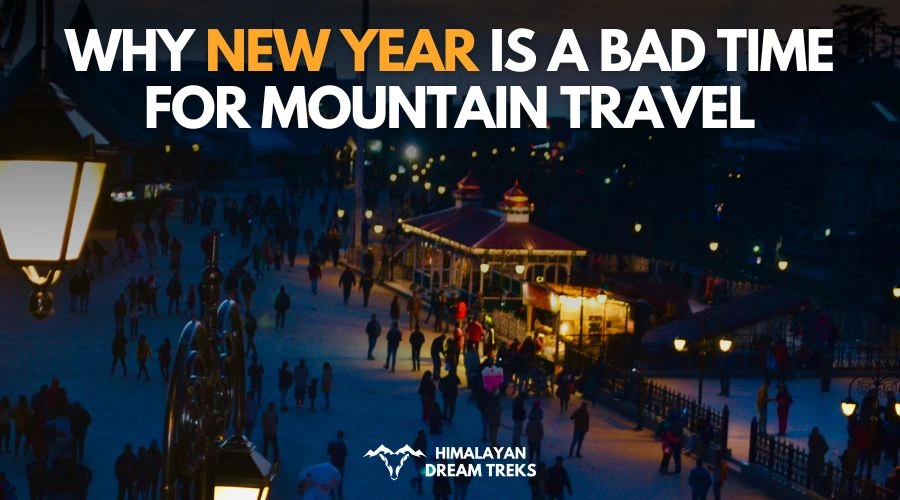
Every year, as December ends, the mountains quietly prepare for winter. And every year, thousands of people rush towards them at the same time, chasing snow, celebrations and that “New Year in the mountains” feeling.
What sounds magical on Instagram often turns chaotic on the ground. If you’ve been thankful that you didn’t go to the mountains this New Year, you’re not alone and you’re probably right. In recent years, New Year travel in the Himalayas has shifted from a peaceful escape to an overcrowded crisis.
From jam-packed roads to damaged trails and exhausted local ecosystems, the cost of peak-season travel is far higher than most travellers realise.
Let’s understand why travelling during New Year holidays is often a bad idea for you, for locals, and for the mountains themselves.
In early January, headlines across India told a similar story.
One of the most striking examples came from Kedarkantha, one of Uttarakhand’s most popular winter treks. Reports showed over 1,500 trekkers reaching the summit around 2:30 AM on New Year’s Day, not for solitude or sunrise, but to “celebrate”.
Imagine a Himalayan summit at night: Headlamps everywhere, long queues, noise, rushed descents and zero silence.
This isn’t an isolated case.
Places like Manali, Rishikesh, Mukteshwar, Dharamshala and even smaller hill towns have repeatedly reported:
- Massive traffic jams lasting 8/12 hours
- Complete road blockages
- Emergency vehicles are struggling to move
- Shortage of accommodation and basic facilities
What should be a refreshing break often turns into stress at altitude.
Table of Contents
Why New Year travel create chaos in the Himalayas
Everyone Travels at the Same Time
New Year holidays combine:
- School winter breaks
- Office leaves
- Festive travel mindset
This leads to compressed travel demand. Lakhs of people heading to the same few destinations within a narrow window of 7–10 days. The Himalayas are not built to handle this kind of sudden population pressure. Roads are narrow. The weather is unpredictable. Emergency response is limited. Yet, everyone wants to be there right now.
Price Hikes Ruin the Experience
Peak demand leads to peak prices.
During the New Year:
- Hotel prices shoot up by 2-4x
- Transport costs increase sharply
- Trek permits, guides, and logistics become expensive
Ironically, you pay more money for less comfort, more crowd and poorer service. What should be a soulful mountain trip becomes an overpriced compromise. Over-tourism would be damaging even in a stable climate. Unfortunately, the Himalayan climate is changing fast. Meteorological data from Gulmarg and Pahalgam shows a clear warming trend:
In Pahalgam, the average minimum winter temperature rose from –6.02°C (1981–1990) to –4.12°C (2001–2010) Average maximum temperatures also increased from 5.1°C to 7.0°C in the same period. Gulmarg recorded an overall rise of nearly 1.7°C in average temperatures, with winter temperatures staying above normal for most of the last decade.1 Why does this matter for trekkers and New Year travel? Because warmer winters mean earlier snow melt.
Overcrowding Damages Trails and Ecology
This is where the problem becomes serious.
Popular treks like Kedarkantha, Brahmatal, Triund, and Nag Tibba witness thousands of footsteps in a very short time. Trails that are meant to recover slowly under snow pressure instead face:
- Soil erosion
- Trampled vegetation
- Waste accumulation
- Disturbed wildlife patterns
The Himalayas are young and fragile mountains. Unlike older ranges, they erode faster and take longer to heal. When everyone walks the same trail, at the same time, the mountain pays the price. Overcrowding in the Himalayas during peak travel periods isn’t anecdotal anymore. It’s measurable.
According to long-term tourism data from Pahalgam and Gulmarg, tourist inflow has shown sharp spikes over short periods. For instance, Gulmarg saw tourist numbers jump from under 600,000 in 2010 to over 1.4 million in 2011, while Pahalgam crossed 1.35 million tourists in the same year. These are not gradual increases; they are sudden surges.
Researchers studying tourism vulnerability in the Indian Himalayan Region (IHR) note that tourist arrivals can exceed local population capacity by up to 1.6 times, especially during holiday-driven travel windows like New Year. This creates immediate pressure on roads, accommodation, waste systems, and emergency services.
In simple words, The mountains are receiving city-sized crowds without city-sized infrastructure.
Limited Infrastructure Meets Unlimited Crowd
Hill towns are not cities.
Water supply, waste management, parking and electricity are already stretched during winters. During New Year, the sudden population surge overwhelms local systems.
This results in:
- Garbage dumping near trails and villages
- Sewage issues near rivers
- Stress on local communities
Locals don’t just host travellers..they live with the consequences long after the holiday ends. Infrastructure Was Never Designed for This Load. Research published in Current World Environment (2024) highlights that unplanned tourism infrastructure growth in Himalayan hill stations is directly increasing disaster vulnerability.2
The issue isn’t tourism itself, it’s compressed tourism. Colonial-era hill stations like Shimla, Mussoorie, and Nainital were designed for seasonal summer tourism. Today, due to rising temperatures in the plains, tourist inflow has expanded to all seasons, including winters.
The study also warns that ignoring tourist carrying capacity in fragile ecosystems leads to higher risks of landslides, flooding, and infrastructure failure, especially during peak travel periods like New Year.
The Irony: You Go for Peace, You Get the Opposite
Tourism trend analysis post-COVID shows something interesting. In 2021, tourists actively shifted away from overcrowded destinations:
Shimla’s tourist count dropped sharply, while Lahaul & Spiti saw tourist numbers jump from 118,000 (2019) to over 960,000 (2021). This shift proves a simple truth: Travellers want nature but not noise
Smarter Alternatives: When and How to Travel Instead
The good news? The mountains are generous only if you visit them wisely.
Travel in Shoulder Months: February, March, April & November
These months are often ignored, which makes them perfect.
- February/March: Snow still exists, but crowds reduce sharply
- April: Clear skies and stable weather
- November: Crisp air and quieter trails
Most importantly, there are no major public holidays, which means:
- Better prices
- Fewer people
- More authentic experiences
Avoid Summer Vacation Rush Too
May and June see another surge due to school holidays.
If you truly want meaningful travel:
- Plan before or after this window
- Choose customised itineraries
- Avoid one-size-fits-all packages
Choose Offbeat Treks Over Famous Ones
Instead of following the crowd to the same Instagram-famous treks, explore quieter alternatives that offer just as much beauty, sometimes even more.
Some lesser-known Himalayan trails include:
- Moila Top
- Pindari Glacier trek
- Kush Kalyan Bugyal
- Kanamo Peak Trek
- Gulabi Kantha
- Monal Top
These trails:
- Receive fewer trekkers
- Have healthier ecosystems
- Offer better chances of solitude and wildlife sightings
And yes, they still have snow, views, and magic.
The Role of Responsible Trekking Companies
At Himalayan Dream Treks, we strongly believe:
- Less crowd = better experience
- Smaller groups = lower impact
- Customised treks > mass tourism
Responsible trekking is not about avoiding travel. It’s about timing it right and choosing consciously.
When travellers spread across months and trails, everyone benefits:
- Trekkers get better journeys
- Locals get sustainable livelihoods
- Mountains also get time to recover
Final Thoughts
The Mountains Aren’t Going Anywhere. New Year is just one date on the calendar. The Himalayas don’t disappear after January 1st. Snow doesn’t melt overnight. Beauty doesn’t expire with the holiday season. Sometimes, the best travel decision is not going when everyone else is going.
Travel slower. Travel smarter. And let the mountains breathe.
This article draws on research from the India Meteorological Department (IMD), NITI Aayog, Ministry of Tourism and peer-reviewed studies published in Current World Environment (2024) on climate change, tourism trends, and ecological vulnerability in the Indian Himalayan Region.

Leave a Comment